FC Bayern München: Germany's Greatest Club and a Groundhopping Experience Like No Other
There are clubs you know without ever having watched a match. And there are clubs where you know from the start that visiting their stadium is something you have to do at least once. FC Bayern München is both. The most successful football club in Germany, 32-time national champions, six-time Champions League winners, a global club with millions of fans on every continent, and at the same time a club that plays in one of the most impressive arenas in the world. For groundhoppers, Munich is mandat
Advertisement
There are clubs you know without ever having watched a match. And there are clubs where you know from the start that visiting their stadium is something you have to do at least once. FC Bayern München is both. The most successful football club in Germany, 32-time national champions, six-time Champions League winners, a global club with millions of fans on every continent, and at the same time a club that plays in one of the most impressive arenas in the world. For groundhoppers, Munich is mandatory.
History: from a bowling alley to the top of the world
FC Bayern München was founded on 27 February 1900 in a Munich bowling alley by eleven men who split from the then-dominant MTV München because they found the association too bureaucratic. For years the club lived in the shadow of local rivals TSV 1860 München. The great era began in the 1960s, when players like Sepp Maier, Franz Beckenbauer and Gerd Müller came together and launched the club into a different dimension entirely.
In the 1970s Bayern dominated European football. Three consecutive European Cup titles, in 1974, 1975 and 1976, established FC Bayern as the first German superpower on the international stage. Beckenbauer as sweeper, Müller as a goal machine, Maier in goal. A generation that changed German football for ever.
What followed was a continuous story of success, with interruptions and setbacks, but always with the ambition to be at the very top. The 2012/13 season brought the treble of Bundesliga, DFB-Pokal and Champions League. In 2019/20 the club under Hansi Flick won the sextuple, all six available titles in a single season. Robert Lewandowski scored 55 goals in 47 competitive matches that year. Numbers that read like fiction.
32 Bundesliga titles, 6 Champions League trophies, 20 DFB-Pokal wins. That is the record. No other club in Germany comes close.
The Allianz Arena: a groundhopping experience in a class of its own
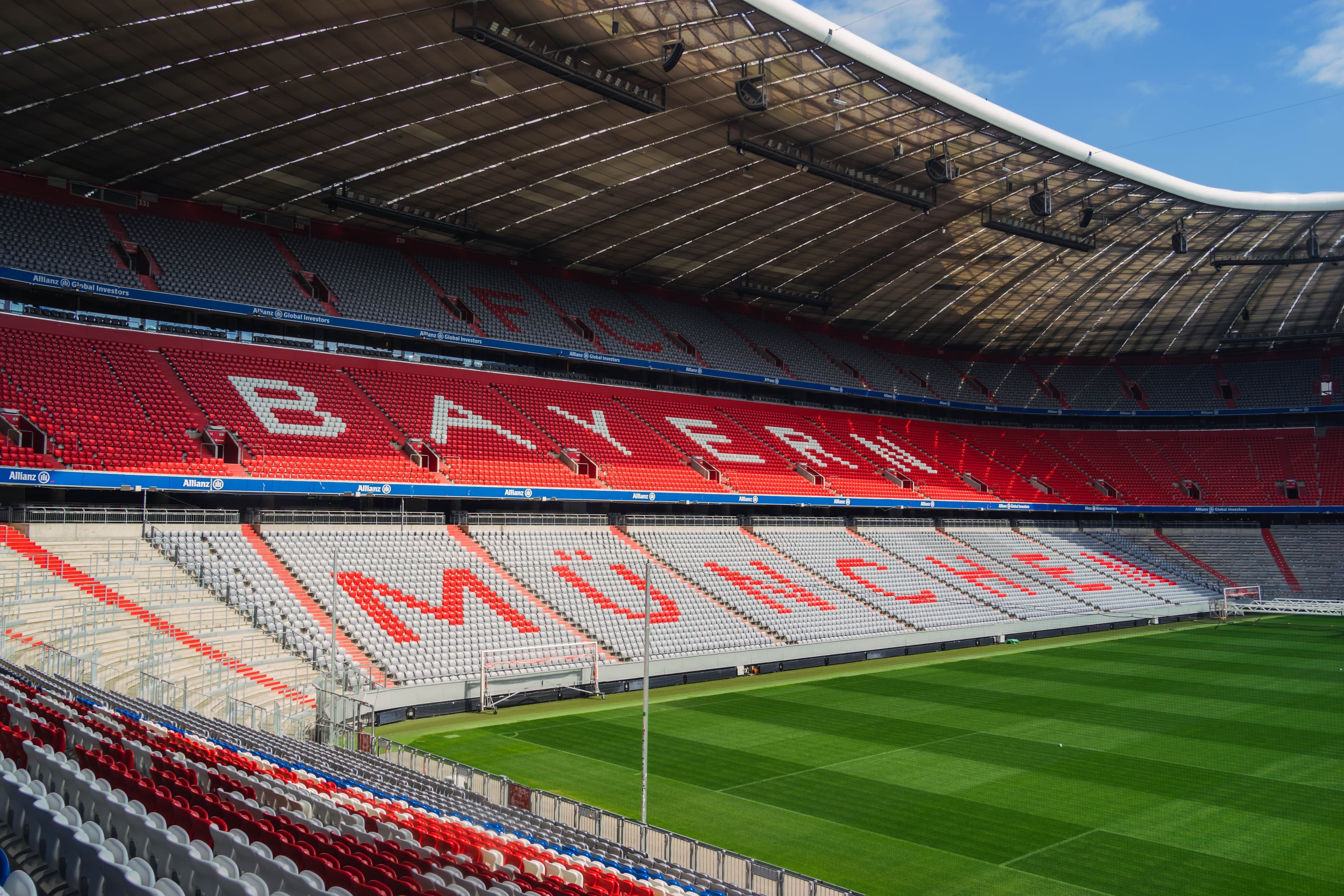
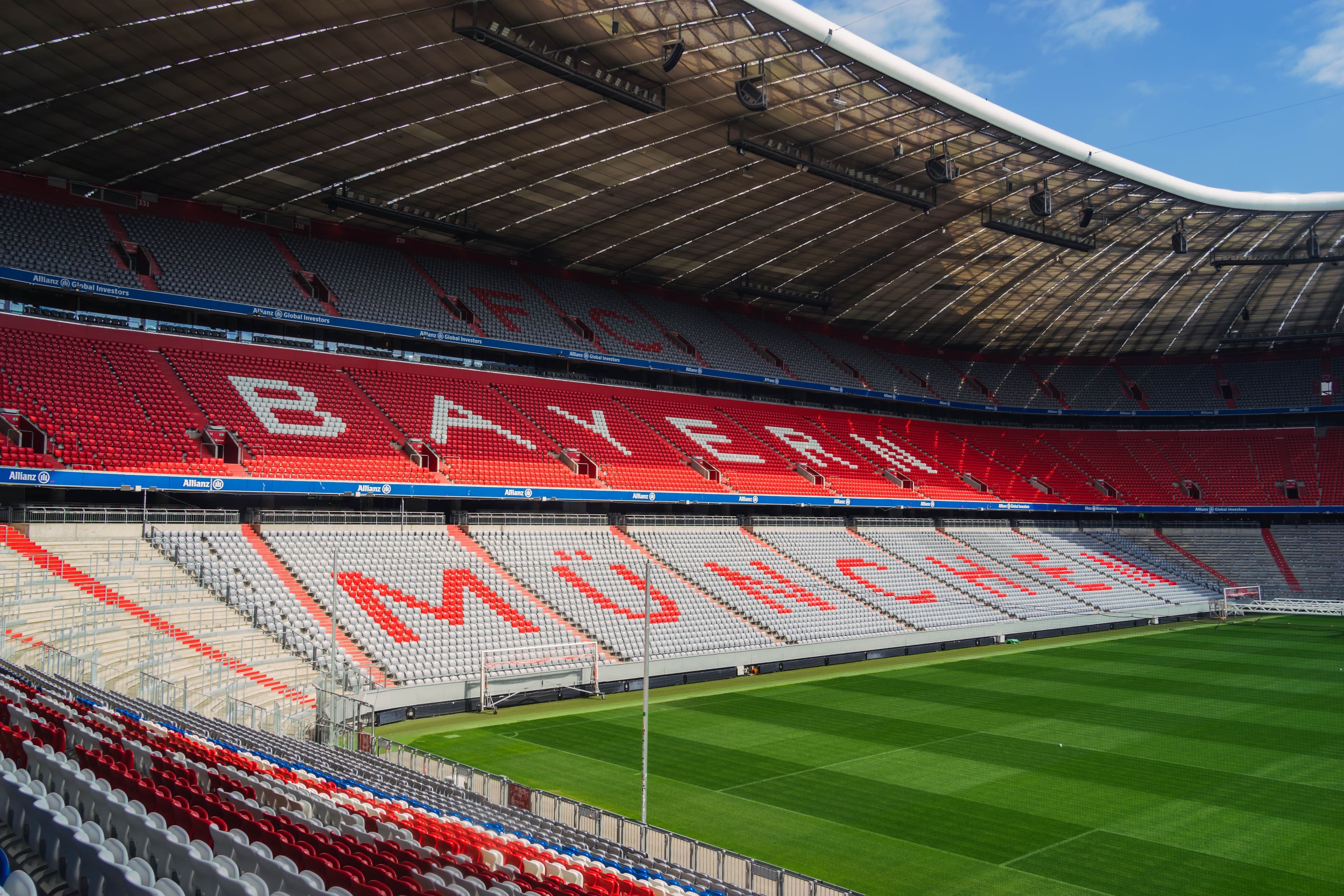
When you talk about FC Bayern München, you cannot avoid the Allianz Arena. The stadium in the north of Munich, right next to the A9 motorway, opened in 2005 and has since become one of the most iconic stadiums in the world. The facade made of 2,874 ETFE plastic cushions can be illuminated in club colours: red for FC Bayern, blue for TSV 1860 München (the former second tenant) and white for the German national team. From the motorway the arena glows like an extraterrestrial spacecraft. Anyone who sees it from a distance for the first time immediately understands why it belongs among the most recognisable stadiums on the planet.
Capacity stands at around 75,000 for Bundesliga matches, making it the second largest football stadium in Germany after the Olympiastadion in Berlin. The Südkurve standing terrace, holding around 10,000 fans, is regarded as one of the loudest and most atmospheric stands in Europe. Anyone who wants to feel the full experience buys a ticket for the Südkurve. No stand in Germany sounds like that one.
The arena was expanded and modernised for the 2006 World Cup and has since hosted numerous Champions League matches, two World Cup group games and a World Cup quarter-final. The 2012 Champions League Final between FC Bayern and Chelsea, lost on home soil after a 4:3 penalty shootout, is one of the most dramatic moments in the stadium's history and in the history of the competition.
For groundhoppers: the Allianz Arena is no hidden gem and it is not a small, weathered jewel like the Ellenfeldstadion. It is the opposite: modern, slick, perfectly organised, with everything a top facility requires. But it is still a mandatory visit, because it is simply and straightforwardly impressive. The scale, the acoustics, the atmosphere when the stadium is full and the view from inside under floodlights are experiences you do not forget.
How to get there
The Allianz Arena is located at Werner-Heisenberg-Allee 25, 80939 Munich. The stadium is directly accessible by U-Bahn, with the Fröttmaning station just a few minutes' walk away. On matchdays the U6 runs at frequent intervals and the journey from the city centre takes around 20 minutes. Those arriving by car will find plenty of parking on the site but should arrive early, as access roads fill up quickly for big matches.
The area around the arena is spacious. It is worth walking around the outside of the stadium, taking in the illuminated facade and visiting the FC Bayern Museum right next to the ground, which documents the entire history of the club. For groundhoppers who want to feel the weight of Bayern's history, the museum is essential.
The rivalries: Dortmund, 1860 and beyond
FC Bayern is Germany's most successful club, which automatically makes them the favourite rival of many. The most intense domestic rivalry is with Borussia Dortmund. The Bundesliga top fixture between Bayern and Dortmund, known as Der Klassiker, is the most watched Bundesliga match of the year. Anyone who wants to experience this match at the Allianz Arena needs to plan well ahead. Tickets are extremely sought after and sell out fast.
Historically interesting is also the city rivalry with TSV 1860 München. The Sechzger, as they are called, now play in the 3. Liga, but for years they were the more popular Munich club. The last Bundesliga derby between Bayern and 1860 took place decades ago, but the city rivalry lives on in the streets, in the pubs and on the pitches across the city.
Groundhopping in Munich: more than just the Allianz Arena
Munich offers groundhoppers more than one stadium. Alongside the Allianz Arena there is the Olympiastadion, where FC Bayern played from 1972 to 2005 and which today is used for concerts and smaller events. The Olympiastadion is a groundhopping classic in its own right, with Frei Otto's unique tent roof construction and the history of the 1972 Summer Olympics.
Add to that the many grounds in Munich's districts and surrounding area. The Bayernliga and the Landesligen offer matches every weekend in small, characterful facilities where admission costs five euros and the club bar still cooks its own food. Anyone who was at the Allianz Arena on Saturday and turns up at Unterhaching or Wacker München on Sunday experiences Bavarian football across its full range.
FC Bayern in the Ground Hoppers App
The Allianz Arena is listed in the Ground Hoppers App. You find Bayern home matches directly in the Nearby screen or in the fixture list, check in when you enter the grounds and have the visit saved in your personal groundhopping statistics. The app also shows you all other grounds in the Munich area, from the Olympiastadion to the Grünwalder Stadion of TSV 1860 all the way to the smallest Bezirksliga pitches in the region.
Particularly useful: the nearby search filters by radius, date and league. Anyone arriving in Munich on a Friday sees at a glance which matches are taking place in the region over the weekend and can spontaneously add one or more new grounds to the route.
Download now:
Apple App Store: https://apps.apple.com/app/ground-hoppers-app/id6761360137
Google Play Store: https://play.google.com/store/apps/details?id=app.groundhoppers.mobile
Conclusion: Bayern München is mandatory, the Allianz Arena is an experience
You do not have to like FC Bayern to make the Allianz Arena an unforgettable groundhopping experience. The stadium, the atmosphere, the scale and the history are more than enough. Any groundhopper seriously working their way through Germany cannot skip Munich. And anyone who has stood in the Südkurve when 75,000 people shake the Bayern block on a Champions League evening understands why this stadium cannot be missing from any groundhopping list.