Olympiastadion Berlin: Where History and Football Collide
There are stadiums you walk into and know immediately that you are somewhere extraordinary. The Olympiastadion Berlin is one of them. Not a modern construction of glass and steel, not a new build on an empty lot, not a faceless multi-purpose bowl. The Olympiastadion Berlin is a place with weight, with history, with an aura that cannot be recreated. Anyone who has not yet visited it has one of the most extraordinary groundhopping addresses in Europe still ahead of them. Location and how to get
Anzeige
There are stadiums you walk into and know immediately that you are somewhere extraordinary. The Olympiastadion Berlin is one of them. Not a modern construction of glass and steel, not a new build on an empty lot, not a faceless multi-purpose bowl. The Olympiastadion Berlin is a place with weight, with history, with an aura that cannot be recreated. Anyone who has not yet visited it has one of the most extraordinary groundhopping addresses in Europe still ahead of them.
Location and how to get there
The Olympiastadion is located in the Berlin district of Charlottenburg-Wilmersdorf, in the western part of the city, around seven kilometres from the Brandenburg Gate. The address is Olympischer Platz 3, 14053 Berlin. The stadium is excellently served by U-Bahn and S-Bahn, with the Olympiastadion station directly adjacent to the site. From Berlin Hauptbahnhof the S-Bahn takes around 20 minutes.
The stadium grounds are expansive. Around the arena you find the Maifeld, the Bell Tower, the Schwimmstadion and the Sportforum, all part of the historic ensemble from the 1930s. Anyone arriving early should plan at least an hour for the grounds before kick-off.
History: from 1936 to today
The history of the Olympiastadion begins in 1934, when construction started on the orders of the National Socialist regime. Designed by Werner March, the stadium was opened for the 1936 Summer Olympics. Jesse Owens won four gold medals in Berlin, directly refuting the racial ideology of the hosts on the field where it counted most.
After the Second World War, the stadium lay in the British sector of Berlin and continued to be used, first by British forces, later again for sport. Hertha BSC began playing at the Olympiastadion in the 1960s, and when the club was promoted to the Bundesliga in 1968, a new era began for the stadium as a football home.
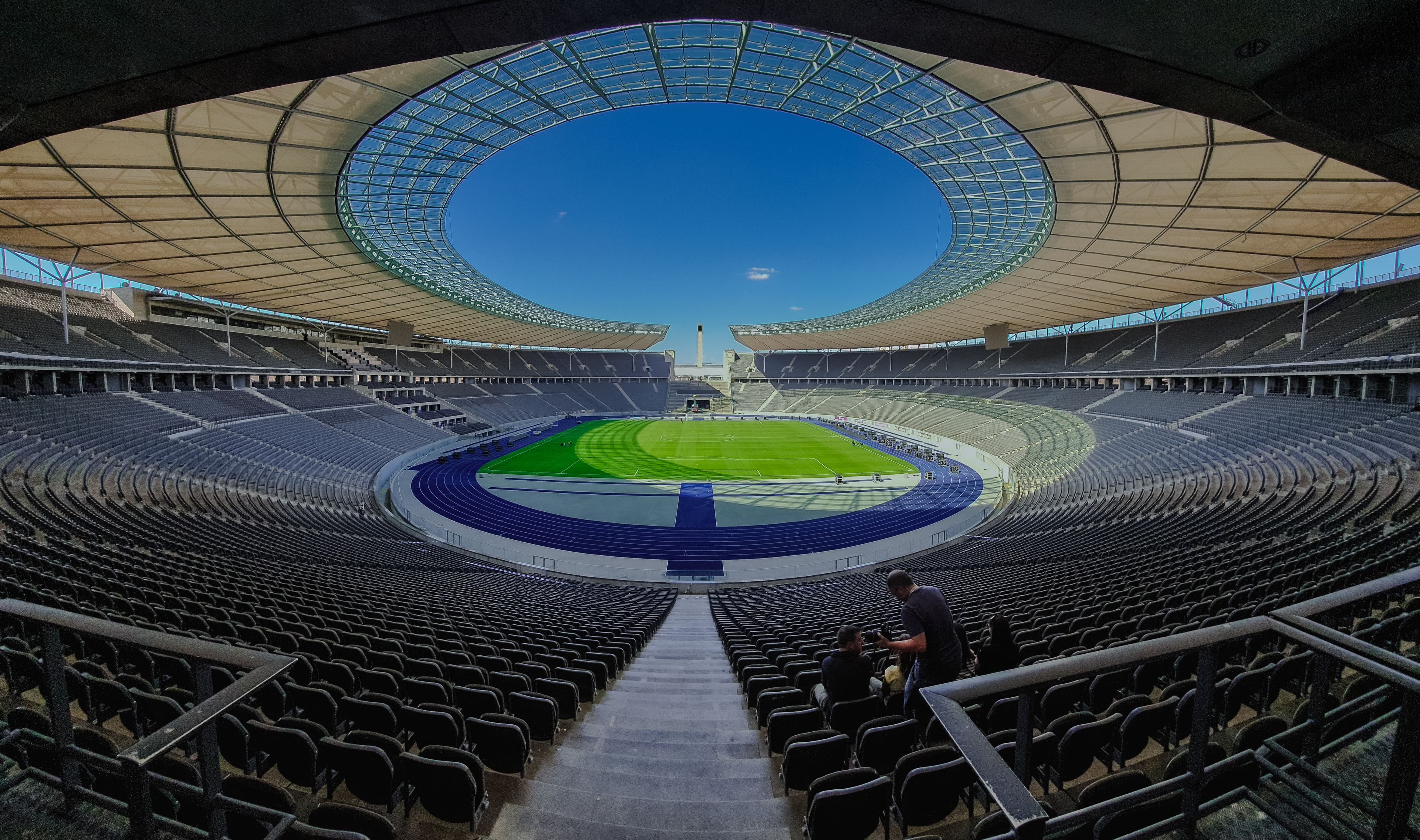
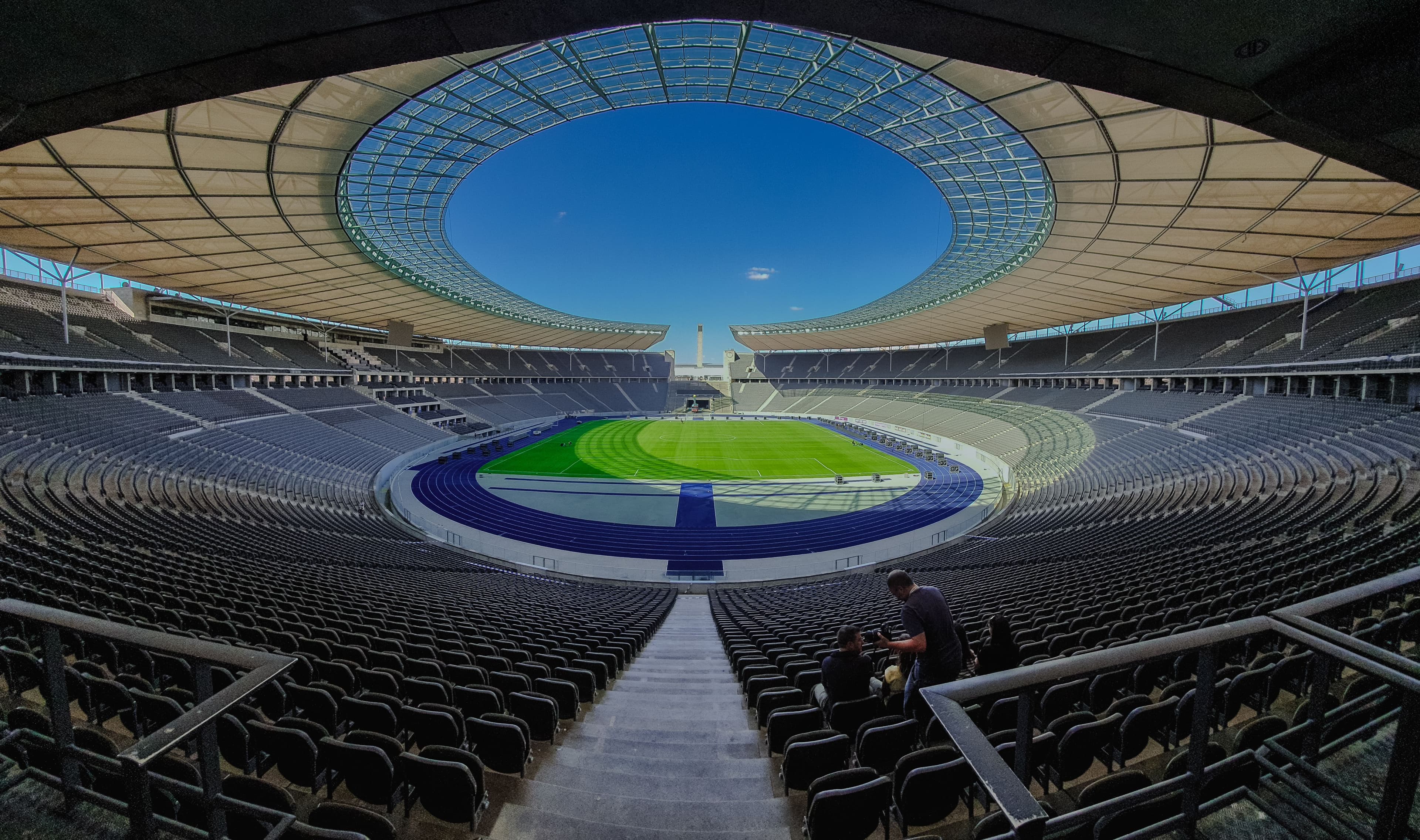
Between 2000 and 2004, the Olympiastadion was comprehensively renovated and modernised at a cost of 242 million euros. A new membrane roof now spans the terracing, the capacity was set at around 74,000 for football matches including over 11,000 standing places on the Ostkurve. The playing surface was lowered, the running track renovated and the entire infrastructure renewed, while the historic shell limestone facade was preserved.
In 2006 the Olympiastadion hosted the FIFA World Cup Final between Italy and France, decided 5:3 on penalties after extra time. The image of Zinedine Zidane being led off the pitch after his headbutt on Marco Materazzi is one of the most iconic moments in football history, and it happened here, in Berlin.
In 2015 the stadium hosted the UEFA Champions League Final between FC Barcelona and Juventus Turin (3:1 for Barça). And in 2024 it staged the UEFA European Championship Final, where Spain beat England 2:1.
Hertha BSC: the home side in Germany's largest stadium
The principal tenant is Hertha BSC. The club currently plays in the 2. Bundesliga and is fighting for a return to the top flight. The Olympiastadion at around 74,000 places is the largest football stadium in Germany, which regularly creates a particular contrast: when Hertha plays in the second division, attendance figures can vary sharply depending on the table position and the opponent. Sold-out home matches are rarer at second-division level, which can make the atmosphere thin during difficult spells.
But when the Olympiastadion is full or near full, it is one of the most impressive experiences in German football. The Ostkurve standing terrace is regarded as one of the most atmospheric in the whole league, the sound inside this enormous bowl is unique and the image of the illuminated roof during floodlit evening matches is among the most beautiful sights in German football.
The architecture: shell limestone and membrane roof
What makes the Olympiastadion so special is the tension between old and new. The yellowish shell limestone facade, the archways, the columns and the sculptural external elements date from the 1930s and are listed as protected monuments. Behind them lies a modern arena with state-of-the-art infrastructure, excellent sightlines from every seat and a membrane roof covering the entire seating area.
Particularly striking is the Marathon Gate on the western side, which frames an unobstructed view of the Bell Tower and the Maifeld. It was intentionally left open to preserve the outlook and the connection to the surrounding complex. This architectural detail makes the Olympiastadion one of the most photographically rewarding stadiums anywhere.
Concerts and events: more than just football
The Olympiastadion is not only a football ground but one of the most significant event venues in Europe. The Rolling Stones have played here, as have Michael Jackson, Rammstein, U2, Beyoncé, Taylor Swift and many others. For groundhoppers visiting Berlin on a non-matchday, stadium tours run regularly and offer insights into the history of the site and its architecture.
Groundhopping at the Olympiastadion: what you need to know
For groundhoppers the Olympiastadion is a mandatory visit, but one that rewards preparation. The grounds are extensive, security checks take longer than at smaller stadiums and the walk from the entrance to your seat can take several minutes depending on the sector. Arriving early is worthwhile.
The atmosphere varies considerably depending on the division, the opponent and the table situation. A top match in the Bundesliga with 70,000 in attendance is a completely different experience from a routine second-division fixture with 30,000. Both are interesting for groundhoppers, but for different reasons.
Particularly recommended are floodlit evening matches. The illuminated roof, the backdrop and the acoustics at night transform the Olympiastadion into a place that is hard to describe and harder to forget.
Olympiastadion Berlin in the Ground Hoppers App
The Olympiastadion Berlin is listed in the Ground Hoppers App as a ground. You find Hertha matches directly in the Nearby screen or in the fixture list, check in when you enter the grounds and have the visit permanently saved in your personal groundhopping statistics. Anyone who has the Olympiastadion on their list can tick it off; anyone who does not knows what comes next.
The Ground Hoppers App also shows you all other Berlin grounds in the surrounding area, from Union Berlin's Stadion An der Alten Försterei to the Friedrich-Ludwig-Jahn-Sportpark and the many smaller grounds across Berlin's districts. Berlin as a groundhopping destination fills a whole weekend on its own.
Download now:
Apple App Store: https://apps.apple.com/app/ground-hoppers-app/id6761360137
Google Play Store: https://play.google.com/store/apps/details?id=app.groundhoppers.mobile
Conclusion: the Olympiastadion is not a stadium, it is an experience
Anyone entering the Olympiastadion Berlin for the first time needs a moment. The scale, the height, the shell limestone, the roof, the view through the Marathon Gate to the Bell Tower. This is not a normal football ground. It is a place where history was made, good and bad, and that still carries that history in its walls.
For groundhoppers it is one of the unmissable places in Germany. Not because Hertha is currently in the Champions League. But because this stadium has witnessed more than most of us ever will. And because you feel that, from the first step inside to the last look back when you leave.